
Leaked UFC Texts Reveal the Hidden Reality Behind Fight Negotiations
Newly leaked messages between UFC matchmaker Mick Maynard and fighter manager Marcelo Brigadeiro have revealed exactly how behind-the-scenes negotiations work in the world’s biggest MMA promotion. The texts center around Chinese UFC fighter Su Mudaerji and show how the UFC handles contracts, pay, and matchmaking. The leak provides a rare glimpse into the power dynamics between matchmakers, managers, and fighters — and highlights how performance alone doesn’t dictate a fighter’s future.
How the UFC Negotiation Texts Were Leaked
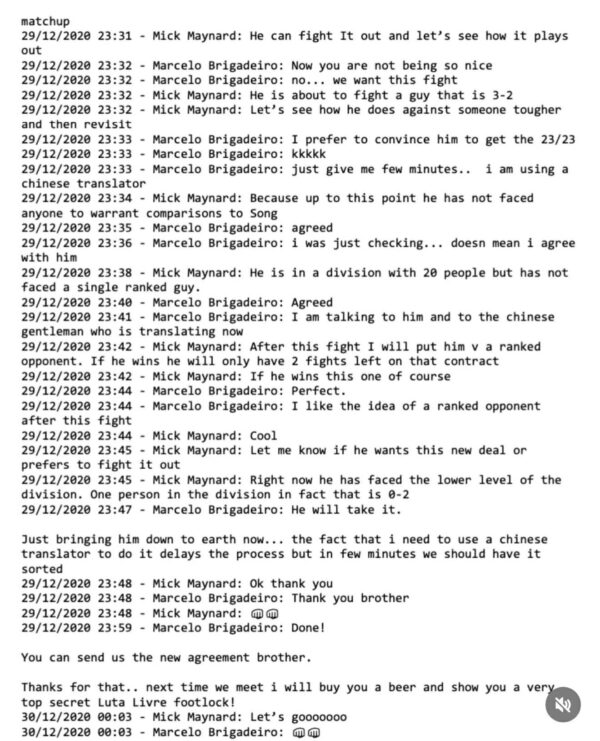
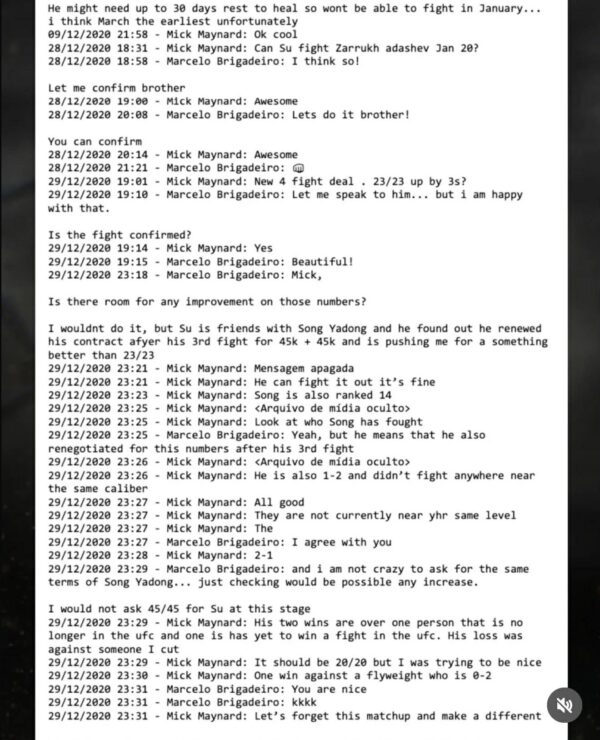
The messages come from a legal case in Brazil in which private WhatsApp conversations between UFC matchmaker Mick Maynard and Su Mudaerji’s manager Marcelo Brigadeiro were made public. One exchange shows Maynard proposing a new four-fight deal for Mudaerji:
“New four fight deal: 23/23 with 3k more per win?”
That would mean $23,000 to show and another $23,000 to win — totaling $46,000 per win (approximately 475,000 SEK). Additionally, each victory would increase his pay by $3,000 going forward. Brigadeiro pushed back, referencing Song Yadong, another Chinese UFC fighter, who reportedly negotiated a $45,000/$45,000 deal after three fights — roughly 930,000 SEK per win.
“What’s the point of having a manager if he doesn’t push for a better deal? lol”, Brigadeiro wrote.
Maynard responded firmly, explaining that Su hadn’t yet faced ranked opponents and needed to prove more before earning a better deal:
“Right now he hasn’t fought anyone in the top tier. He has to show more.”
This exchange highlights how UFC negotiators assess a fighter’s value based on performance level, matchmaking history, and perceived upside — not just marketability or nationality.
Who Is Su Mudaerji?
Su Mudaerji is a Chinese mixed martial artist competing in the UFC’s flyweight and bantamweight divisions. Born in Ngawa, Sichuan, he fights out of Enbo Gedou Gym — one of China’s premier MMA camps. Mudaerji made his UFC debut in 2018 and quickly built a reputation for being one of the most explosive strikers in his division.
At the time of the leaked negotiations, Mudaerji held a UFC record of 2–1 with wins over fighters like Zarrukh Adashev and Andre Soukhamthath. He’s known for his aggressive stand-up game and knockout power: 13 of his 16 career wins have come by KO/TKO.
Mudaerji is currently scheduled to return to the octagon at UFC 326 on March 7, 2026, where he will face Mexican flyweight Jesús Santos Aguilar. The bout could prove pivotal for his future in the division — especially considering how contract negotiations are so closely tied to performance.
How the UFC Structures Fighter Pay
The text exchange between Maynard and Brigadeiro reveals how heavily the UFC relies on performance-based contracts. These usually include a base pay (“show money”) and a win bonus. Mudaerji’s offer of $23,000/$23,000 was typical for unranked fighters early in their UFC careers.
Top contenders and champions earn significantly more, but most fighters start with lower deals and must work their way up. The UFC’s model incentivizes winning but places pressure on fighters to perform under financially risky conditions.
When Brigadeiro asked for more money for his fighter, Maynard emphasized that Mudaerji hadn’t proven himself yet:
“He hasn’t fought anyone ranked. Let’s see how he performs first.”
This makes it clear that matchmaking and opponent quality are key factors in contract discussions — not just a fighter’s marketability or record.
Limited Power for Managers
Brigadeiro tried to leverage comparisons to other fighters to improve his client’s contract, but Maynard wasn’t persuaded. Instead, the matchmaker explained that each case is unique and reminded him that UFC controls matchmaking and pay offers.
“I’m just trying to help him understand reality,”
Brigadeiro wrote in another message, explaining that he needed a translator to explain the situation to Mudaerji. This reinforces the idea that managers often operate with limited leverage. While they can advocate for better pay, final decisions rest with the UFC matchmakers.
UFC Uses Matchmaking as a Negotiation Tool
One of the most revealing aspects of the conversation was how Maynard appeared to link fighter demands to opponent difficulty. In effect, a fighter who negotiates too hard may be rewarded not with a better deal — but with a tougher matchup.
“He’s about to fight a guy who is 3–2… let’s see how that goes.”
This suggests that UFC uses matchups to test a fighter’s worth before improving contracts. Fighters who succeed against increasingly difficult opponents can renegotiate — but those who fall short lose bargaining power. It’s a clear message: fight, win, and earn your contract. Fail, and risk stagnation.
What This Means for Fans and Fighters
These messages expose a side of UFC operations rarely seen by the public. For fans, it’s a reminder that not all matchups are made purely based on merit. Behind each bout is a web of negotiations, risk assessments, and long-term planning. A fighter’s record is only part of the equation.
For fighters, the takeaway is even more serious. Winning isn’t enough — success in the UFC also depends on negotiation strategy, timing, management, and the willingness to accept tough matchups on less-than-ideal contracts.
Standout quotes from the texts include:
“He’s not worth that money.”
“Let’s forget this matchup — we’ll do another.”
“I get why you’re trying… but this isn’t the right time.”
These lines reveal how tightly UFC controls the careers of its fighters. Matchmakers hold the power, while managers play a secondary — yet still critical — role in navigating the system.